
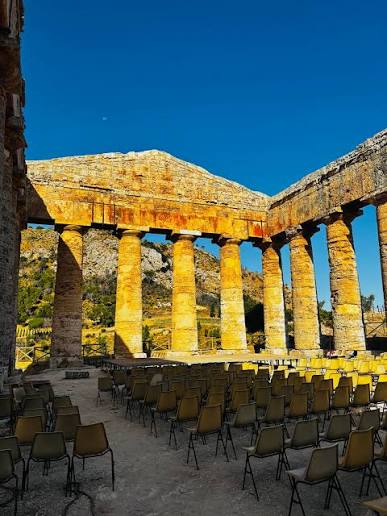
Doric Temple of Segesta
On a hill just outside the ruins of ancient Segesta, overlooking the Gulf of Castellammare, stands an unusually well-preserved Doric temple, thought by some to have been built around 420 BC by an Athenian architect. Its six-by-fourteen columns and unfinished details—including unfluted shafts and lifting tabs left in place—suggest that construction was never completed, while its association with the indigenous Elymians makes it a particularly intriguing Greek-style monument.
Read the full description
On a hill overlooking the Gulf of Castellammare, just outside the ruins of ancient Segesta, stands an unusually well-preserved Doric temple. Thought to have been built around 420 BC, possibly by an architect from Athens, it is often regarded as one of the finest surviving examples of Doric architecture in Europe.
The temple has six by fourteen columns, set on a three-stepped platform measuring 21 by 56 metres. Its survival is particularly remarkable given the destruction caused by the Carthaginian sacking of Segesta, while its position gives the monument a commanding presence above the surrounding landscape.
Several details suggest that construction was never completed. The columns remain unfluted, as they would typically have been in a finished Doric temple, and the tabs used to lift the blocks of the base into position were never removed.
Its history is also distinctive: although unmistakably Greek in architectural character, the temple served a city inhabited by the indigenous Elymian people rather than a Greek population. Segesta was established before it began appearing in Greek records, despite the claim by Greek historians that it had been founded by colonists from Troy.
Gallery
Information
Address
Contrada Barbaro, 91013 Calatafimi-Segesta TP, Italy