
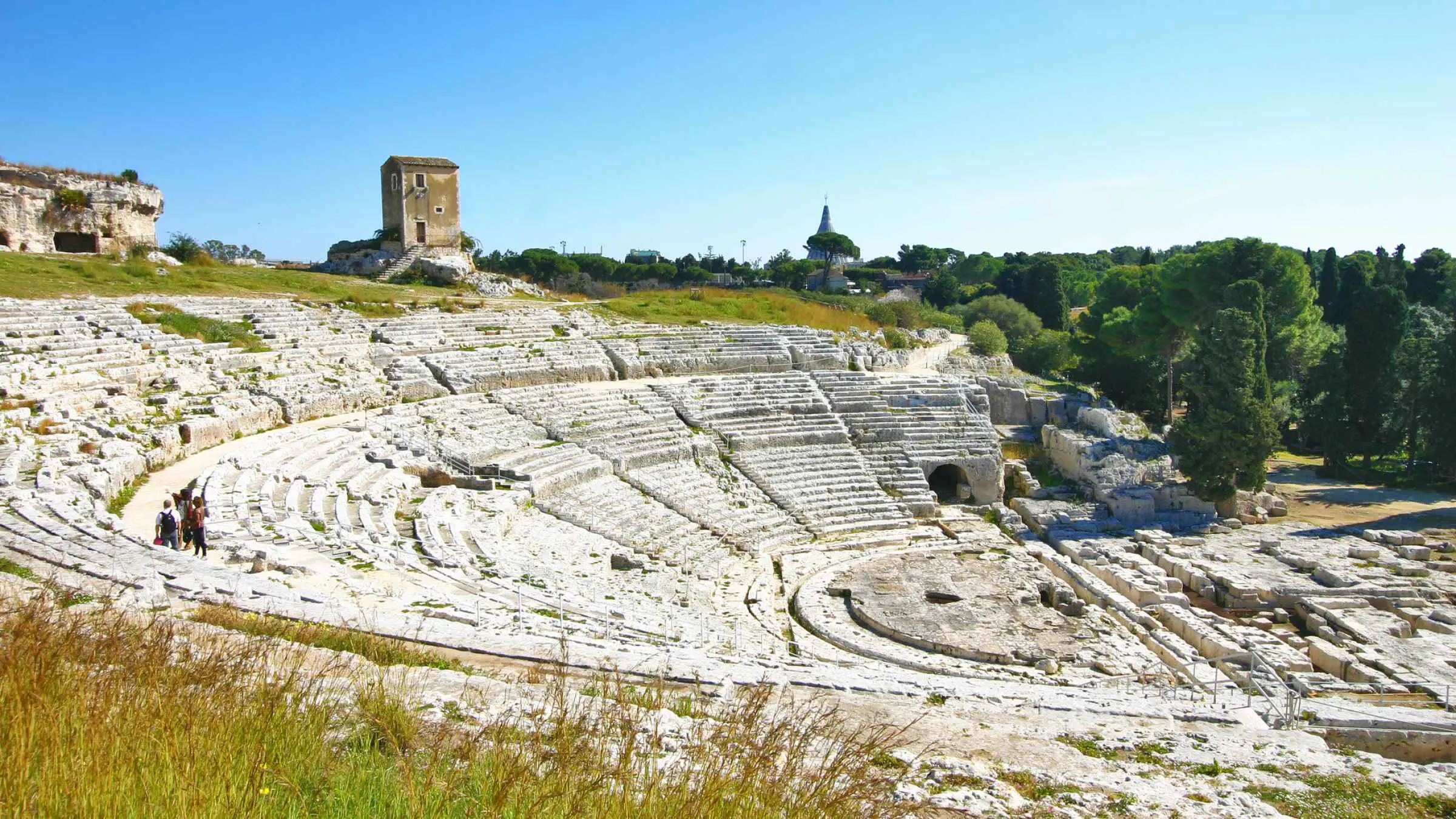
The Greek Theatre of Syracuse
The Greek Theatre of Syracuse lies on the south slopes of the Temenite hill, overlooking the modern city of Syracuse in southeastern Sicily, Italy. It was first built in the 5th century BC, rebuilt in the 3rd century BC and renovated again in the Roman period The theatre represents the greatest example of theatrical architecture in Western Greece. It is unique in that it is almost entirely carved into the rock. In addition to performances, as was customary among the ancient Greeks, the theater was used for popular assemblies.
Read the full description
The Greek Theatre of Syracuse lies on the southern slopes of the Temenite hill, overlooking the modern city. First built in the 5th century BC, it was rebuilt in the 3rd century BC and renovated again during the Roman period. Almost entirely carved into the rock, it represents the greatest surviving example of theatrical architecture in Western Greece. As in other Greek cities, it served not only for performances but also for popular assemblies.
The theatre is composed of three principal elements: the koilon, or cavea, the orchestra and the stage. The semicircular cavea measures more than 138 metres across, with 67 tiers of steps divided into nine wedges by eight service stairways. A broad passage, the diazoma, crosses it widthwise; along its upper face are inscriptions naming the deities or rulers to whom the wedges were dedicated. The names of Queen Philistis and Nereide, the wife and daughter-in-law of Hiero II, remain legible.
The upper part of the cavea is now missing the blocks once placed there, removed in the 16th century during the reign of Charles V because the rock was lacking. In the orchestra, grooves enclose a trapezoidal space. These have been interpreted either as drainage channels, or as traces of an earlier form of the theatre itself.
A large covered portico once surrounded the upper theatre. Above it, the rock face is punctuated by rectangular recesses, or naiskoi, intended to hold small panels known as pinakes, bearing votive images of deities or heroised deceased figures. At the centre, aligned with the theatre, a substantial cave receives water from the Greek aqueduct. This cave-nymphaeum is identified with the Mouseion, the headquarters of the artists’ guild.
The theatre is at Via Luigi Bernabò Brea, 96100 Siracusa. Admission is free and advance booking is not required.
Gallery
Information
Address
Via Luigi Bernabò Brea, 96100 Siracusa SR, Italy